
PCOS is now PMOS. It's more than a name change. It's a new way of understanding the condition.


By Julie Brownley, MD, PhD
Founder, Psychiatry for Women
For years, one of the most common hormonal disorders affecting women has had a name that didn't accurately describe it.
Polycystic Ovary Syndrome (PCOS) has officially been renamed Polyendocrine Metabolic Ovarian Syndrome (PMOS) following a global consensus involving more than 22,000 patients and healthcare professionals from 56 organizations around the world.
Is this just medicine being overly academic?
Not at all. In many ways, the new name reflects one of the biggest shifts in how we understand women's health over the past several decades.
First, what was wrong with the term, "PCOS"?
The biggest problem? Most women with PCOS don't actually have ovarian cysts.
The "cysts" seen on ultrasound are actually many small immature follicles that stopped developing—not true pathological cysts.
That seemingly small misunderstanding has had huge consequences.
Many women have been told:
"Your ultrasound is normal, so you don't have PCOS."
Or they've assumed:
"If I don't have ovarian cysts, this can't explain what's happening."
Neither is true. Even worse, focusing on the ovaries caused clinicians, and patients to overlook that this is really a disorder affecting multiple hormone systems throughout the body.
So, what does PMOS stand for?
Let's break it apart.
Poly = many
Multiple body systems are involved. This isn't just an ovarian condition.
Endocrine = hormone system
The endocrine system includes all of the body's hormone-producing organs.
PMOS involves disturbances in several hormonal pathways simultaneously, including:
insulin
testosterone and other androgens
LH and FSH
anti-Müllerian hormone (AMH)
ovarian hormones
hypothalamic signaling
Instead of one hormone being "off," it's more like an orchestra that has fallen out of sync.
Metabolic = energy regulation
This may be the biggest reason for the name change. Researchers now recognize that metabolism isn't simply an "extra feature" of PCOS. For many women, it's central to the condition.
Common metabolic features include:
insulin resistance
prediabetes
type 2 diabetes
fatty liver disease
abnormal cholesterol
high blood pressure
sleep apnea
increased cardiovascular risk
Not every woman develops all of these. Not every woman has obesity.
But metabolism is involved far more often than people realize, even in women who appear lean.
Ovarian
The ovaries still matter. Ovulation problems remain one of the defining features of the syndrome.
Women may experience:
irregular periods
infrequent ovulation
infertility
elevated AMH
multiple small follicles on ultrasound
The ovaries are still part of the story.
They're just no longer considered the entire story.
So what actually causes PMOS?
This is where things get interesting. Researchers increasingly view PMOS as a self-reinforcing cycle rather than one single hormonal abnormality.
Think of several feedback loops feeding one another:
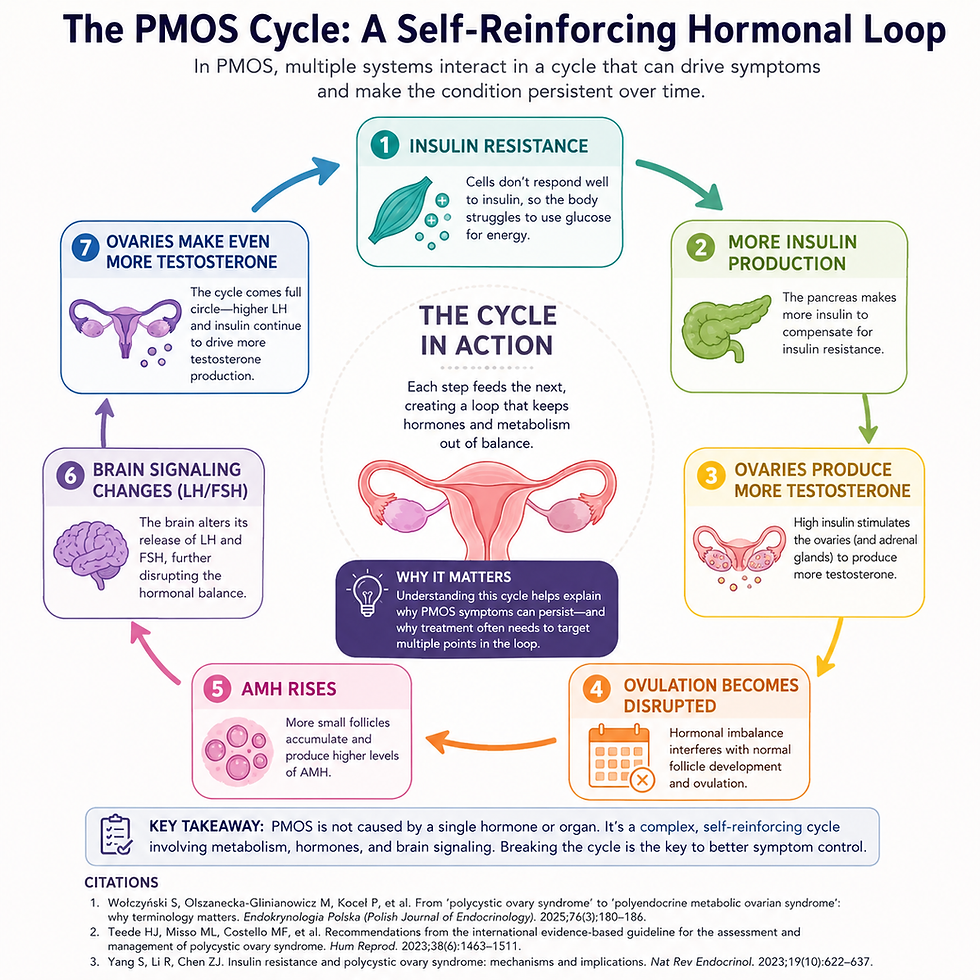
…and around the cycle goes. The Nature Reviews article illustrates this beautifully, showing how the brain, pancreas, liver, ovaries, adrenal glands, and adipose tissue all interact in this network.
It's not "just a fertility disorder"
Historically, many women only learned about PCOS when trying to become pregnant.
Today we know it can affect health throughout life.
Potential effects include:
Reproductive
irregular cycles
infertility
miscarriage risk
pregnancy complications
Metabolic
insulin resistance
diabetes
fatty liver
cardiovascular disease
Dermatologic
acne
excess facial hair
scalp hair thinning
Mental health
One area that deserves much more attention.
Women with PMOS experience higher rates of:
depression
anxiety
eating disorders
reduced quality of life
These are increasingly recognized as part of the syndrome, not simply emotional reactions to it.
Does this mean everyone with PMOS has obesity?
No. This is one of the biggest misconceptions. Many women with PMOS have completely normal BMIs.
Some still have insulin resistance. Some develop elevated cholesterol. Some struggle primarily with infertility or elevated testosterone. Others have predominantly metabolic disease.
PMOS is incredibly heterogeneous.
The new name is actually intended to remind clinicians not to overlook metabolic health simply because someone is thin, and not to assume every woman with PMOS has the same presentation.
Does the diagnosis change?
No. For now, only the name has changed.
The diagnostic criteria remain the same.
In adults, diagnosis still requires two of the following three features (after excluding other conditions):
hyperandrogenism
ovulatory dysfunction
polycystic ovarian morphology (or elevated AMH in appropriate settings)
The science hasn't changed overnight.
Our understanding, and our language, has simply caught up with it.
Why I'm Glad About the New Name
It's a mouthful, Polyendocrine Metabolic Ovarian Syndrome, but it's capturing the true physiology. I think this change has the potential to make a real difference.
Over the years, I've met countless women who were told they couldn't have PCOS because they didn't fit the stereotype.
They were too thin.
Their periods were fairly regular.
Their ultrasound didn't show "cysts."
They weren't trying to get pregnant, so no one looked any further.
Meanwhile, they were struggling with acne, hair loss, excess facial hair, insulin resistance, fatigue, anxiety, depression, difficulty losing weight, recurrent miscarriage, or infertility and symptoms that were absolutely consistent with the syndrome.
I've often found myself disagreeing with prior assessments because the diagnostic lens being used was simply too narrow.
The old name unintentionally encouraged that narrow thinking. It kept our attention on the ovaries when the condition is really much bigger than that.
My hope is that PMOS changes the conversation.
When the name itself reminds clinicians to think about endocrine function, metabolism, and ovarian health together, we widen the mental checklist. We become more likely to recognize women whose presentation doesn't fit the "classic" picture.
Just as importantly, patients are becoming more informed.
Understanding that this is a multisystem condition, not simply a fertility disorder or a problem of ovarian cysts, gives women the language to describe their symptoms, ask better questions, and advocate for a more comprehensive evaluation when something doesn't feel right.
No name change will solve underdiagnosis overnight.
But changing how we think about a disease is often the first step toward changing how we diagnose it.
And for the millions of women whose symptoms have been overlooked, minimized, or explained away, I think that's a very meaningful step forward.
About the Author
Julie Brownley, MD, PhD is a psychiatrist specializing in women’s mental health and the founder of Psychiatry for Women. Her work focuses on perinatal mental health, hormonal transitions, and helping women make thoughtful, individualized decisions about their care.
Continue exploring the latest at Psychiatry for Women
References
Teede HJ, Bahri Khomami M, Morman R, et al.; Global Name Change Consortium. Polyendocrine metabolic ovarian syndrome, the new name for polycystic ovary syndrome: a multistep global consensus process. Lancet. 2026;407:2329-2339. doi:10.1016/S0140-6736(26)00717-8.
Teede HJ, Vanky E, Piltonen TT, Stener-Victorin E, Moran LJ, Bahri Khomami M. Polyendocrine metabolic ovarian syndrome in pregnancy: pathophysiology and outcomes. Nature Reviews Endocrinology. 2026. doi:10.1038/s41574-026-01261-w.
Dalamaga M. What's in a name? From PCOS to polyendocrine metabolic ovarian syndrome: A metabolic reframing, promise, controversies, and challenges ahead. Metabolism Open. 2026;30:100479. doi:10.1016/j.metop.2026.100479.
International Evidence-Based Guideline for the Assessment and Management of Polycystic Ovary Syndrome 2023. Monash University; American Society for Reproductive Medicine; European Society of Human Reproduction and Embryology; Endocrine Society; and collaborating organizations. 2023.
National Institutes of Health Office of Disease Prevention. Evidence-Based Methodology Workshop on Polycystic Ovary Syndrome. Bethesda, MD: National Institutes of Health; 2012.
Further Reading
2023 International Evidence-Based Guideline for PCOS
The Lancet Global Consensus on the Renaming of PCOS to PMOS (2026)
Nature Reviews Endocrinology: PMOS in Pregnancy: Pathophysiology and Outcomes (2026)


Comments